Cancer Chronology
by Linden B. (Lindy) Sisk
Last update August 8, 2012, Creede, Colorado
Here is one article on prostate cancer screening which discusses the downside of using a PSA test for screening. Since my cancer was detected solely by a PSA test - my digital rectal exam was normal - I don't agree with the arguments presented.
And I have been journaling my other activities for some years. See, for example, the pages I have built around our travel activities. In just the last week, I have gotten thank you notes from two people who read and enjoyed some of those pages. Another reason is for me to have a record of what happened to jog my own memory.
A personal note. "Yeah, though I walk through the valley of the shadow of death, I shall fear no evil, for though art with me." -- 23rd Psalm
Cancer is a walk through the valley of the shadow of death. With God's grace, you may walk out of the valley into the sunlight - but whatever happens He will be with you. But life is that walk, too. I am now almost 66 years old, and statistically 1 out of 5 people who should be my age have already died.
In the last 11 months, my beloved wife, my aunt, and my father have died, an engagement to be married was broken, and I've had cancer. I have been sustained through those losses by my faith, which came to me unsought three years ago through a miracle by the grace of God. I wish I could give that faith to others, but, alas, I know not how to. Faith is the antidote to fear.
So, here's what happened.
Tristan MacDonald, John Tesdorpf, and I returned in early February from a hiking trip to the Patagonian Andes. I made an appointment for my annual physical with Dr. Jackson Chen in Corpus Christi. As usual, he gave me orders for a blood test, which included a PSA test. I had been getting PSA tests for several years. The 2009 score was 2.4, 2011 - 3.
The blood test results came back a few days later, and my PSA level was at 5.1. The "normal" range is considered to be less than 4. So, Dr. Chen put me on a course of antibiotics, to see if the elevation was due to a minor infection of the prostate, and gave me orders for another PSA test after the antibiotic therapy.
The antibiotic knocked the level down a little, to 4.7, but that's still outside the normal range. Dr. Chen gave me a referral to a Corpus Christi urologist, Dr. William Naismith, but the appointment wasn't until April 9th.
A PSA test performed in Dr. Naismith's office on April 9 showed the PSA test was elevated still more - to 6.7. Dr. Naismith scheduled a biopsy on that basis, which was performed on April 16.
The results were not available until April 26th, and indicated the presence of prostate cancer, with a Gleason score of 7 - which is a fairly serious diagnosis.
Through the personal connection of a friend, I immediately scheduled an appointment with Dr. Gilad Amiel of the Baylor College of Medicine in Houston.
During an office visit on May 9th, Dr. Amiel recommended a DaVinci prostatectomy. That procedure, sometimes referred to as a laproscopic procedure, results in the removal of the prostate, and the construction of a new connection between the patient's bladder and urethra. Four small openings are made in the patient's abdomen, two for cameras and two for surgical instruments, plus a larger opening at the navel, through which the material being removed is extracted, with a sixth opening for an abdominal drain tube. That minimally-invasive procedure, which avoids large abdominal openings, normally results in shorter hospital stays and faster recovery. See the web link for details.
The next day, extensive lab tests were done to attempt to ensure that the cancer was isolated to the prostate, and included blood tests, a CT scan, and an MRI. A bone scan was done the following day, after one of the tests indicated a shadow on a bone, which might have indicated metastisis. That turned out to be negative, which was a good thing, as that would have ruled out surgery, leaving radiation and chemotherapy.
Dr. Amiel, one of the foremost surgeons performing this operation, was scheduled in early June for a trip to China at the invitation of Chinese medical personnel to discuss his work. He tried to get an operating room scheduled for May 28th, but that turned out to be impossible, so the operation was scheduled for June 12th, after his return from China.
I returned on May 31st, for cardiology clearance at the Baylor Clinic, and pre-operation testing and paperwork at St. Luke's Episcopal Hospital.
I arrived back in Houston on June 10. On the 11th, I checked into the Holiday Inn Medical Center, which is only a block from the Baylor Clinic and St. Luke's.
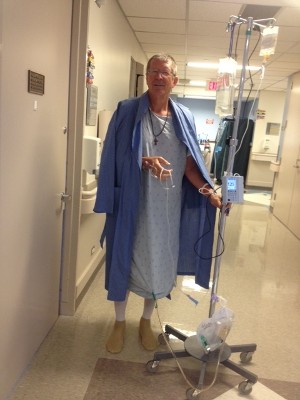
The operation was performed starting at 7:30 AM on Tuesday, the 12th, and lasted for 5 hours. I have no memory of being in the recovery room, or of being moved to my regular room. By the next day, Wednesday, I was up and walking, albeit pushing an IV tree with a urine bag connected to the Foley catheter inserted during the operation to drain my bladder as well as relieve stress on the new connection between my bladder and my urethra.
I was released from the hospital Thursday, June 14th, and returned to the Holiday Inn. That day was the last day that I took pain medication during the day, although I did take a pain pill at night to help me sleep until Sunday. I did have a little abdominal soreness, but it was no worse that the amount of pain I had sometimes had after doing too many situps. I used the pain to help remind me not to move around too quickly.
The Foley catheter did actually help me get a better night's sleep, as I didn't have to get up during the night to go to the bathroom...
I returned to the Baylor Clinic on Wednesday, June 20th. The Foley catheter was removed. Males have three mechanisms for retaining urine. One is the constriction of the urethra by the prostate gland. The other two are the internal sphincter muscle and the external sphincter muscle. A prostatectomy removes the prostate and the internal sphincter, so a male may expect a period of incontinence, until the external sphincter is strengthened, and the body adapts to the different signals of a full bladder. That may take from weeks to months, but eventually the incontinence goes away in most patients.
The best news of that visit was that the pathology report from the tissue removed during the operation, which included the prostate itself as well as numerous lymph nodes, was that there was no indication that the cancer had spread beyond the prostate. No further treatment will be required!
I was instructed not to drive until two weeks after the operation, and a checkup scheduled for July 25th. I was also instructed to walk, as much as I could without becoming exhausted, but under no circumstances to lift anything which weighed more that 10 pounds until the checkup. After that checkup, my next appointment will be six months later.
I checked out of the Holiday Inn on June 25th, and drove down to Rifles Only, where my RV, which I live in, was parked. There I am continuing my recuperation, which includes walking at least 5 miles per day.
I have walked to date more than 80 miles since June 20th. I will return to Houston for a checkup on July 25th, which I expect to remove the restrictions on my activity I've had since the surgery.
Following that checkup, I will move to Creede, Colorado, to join my many friends there for the rest of summer. I expect to be back in Rockport around the first of October.
I had my checkup. The Ultrasensitive PSA Test used to check for any residual cancerous cells returned a value of "undetectable".
There are no further restrictions on my activity except i am not supposed to ride a bicycle for three months. I will return for a routine checkup in October.
I will depart Kingsville for Creede on Sunday. Halleluja!
I am blessed!
I arrived in Creede on July 30. If you are interested in what happens the rest of the summer, take a look at my 2012 Creede Summer Journal.
All Rights Reserved